

Staff Reports
The U.S. and Israel launched a major attack on Iran on Feb. 28, and U.S. President Donald Trump called on the Iranian public to “seize control of your destiny” by rising up against the Islamic leadership that has ruled the nation since 1979.
Iran retaliated by firing missiles and drones towards Israel and U.S. military bases in the region.
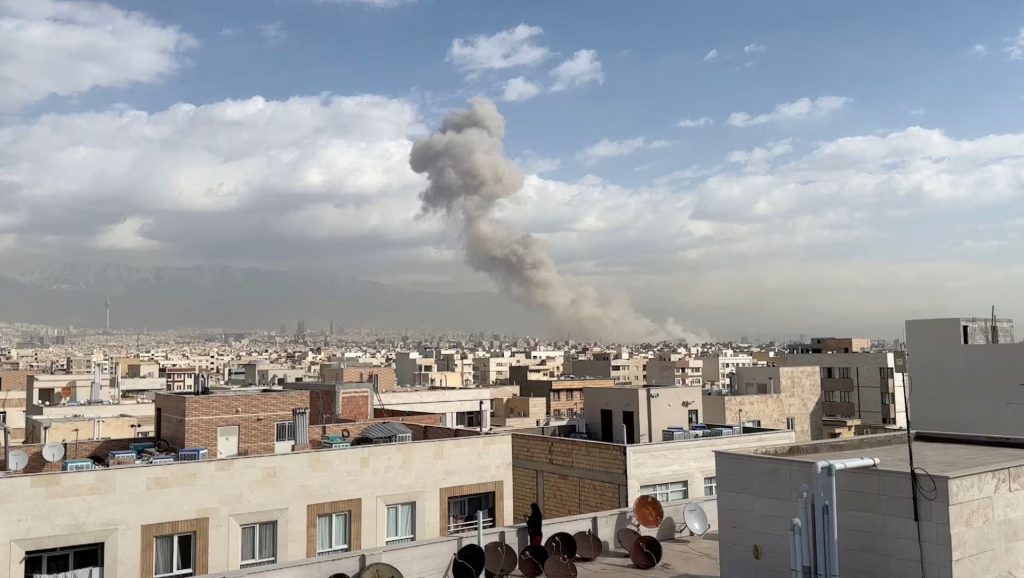
Some of the first strikes on Iran appeared to hit areas around the offices of Supreme Leader Ayatollah Ali Khamenei. Smoke coiuld reportedly be seen rising from the capital as part of strikes that Iranian media said occured nationwide. It wasn’t immeadiately clear whether the 86-year-old leader was in his offices when the attack occured.
Iranian Foreign Minister Abbas Araghchi told NBC News that Khamenei and President Masoud Pezeshkian are alive “as far as I know,” and called the attack “unprovoked, illegal and absolutely illegitimate.”
In a video annoucing the “major combat operations” Trump told Iranians that “when we are finished, take over your government. It will be yours to take. This will probably be your only chance for generations.”
Israeli Prime Minister Benjamin Netanyahu echoed that goal, saying “Our joint operation will create the conditions for the brave Iranian people to take their fate into their own hands.”
The strikes during the holy fasting month of Ramadan opened a new chapter in U.S. intervention in Iran and marked the second time in eight months that the Trump administration has used military force against the Islamic Republic They also came weeks after a U.S. military operation that captured Venezuela’s president, Nicolás Maduro, and brought him and his wife to New York to face federal drug conspiracy charges.
There was no immediate information on whether top Iranian officials had been killed.
A regime change would be a complicated endeavor, given the protracted conflict and because neither the U.S. nor Israel has articulated a vision for what new leadership would look like.
Tensions have soared in recent weeks as American warships moved into the region. Trump said he wanted a deal to constrain Iran’s nuclear program at a moment when the country is struggling at home with growing dissent following nationwide protests.
The immeadiate trigger for the Feb. 28 strikes appears to be the unsuccessful latest round of nuclear talks. But they also reflect the dramatic changes across the region that have left Iran’s leadership in its weakest posistion since the Islamic Revolution nearly hafl a century ago.
Israeli and American strikes in June greatly weakened Iran’s air defenses, military leadership, and nuclear program. A regionwide war, sparked by Hamas’ Oct. 7, 2023 attack on Israel, has left Iran’s network of proxies across the the Middle East greatly weakened. U.S. sanctions and global isolation, meanwhile, have decimated Iran’s economy.
Iran responded to the latest strikes as it had been threatening to do for months, including by launching missiles and drones targeting Israel as well as strikes targeting U.S. military installations in Bahrain, Kuwait, and Qatar.
“The time has come to defend the homeland and confront the enemy’s military assault,” Iran’s Foreign Ministry said in a statement on X.
At least 57 people were reportedly killed at a girls’ school in southern Iran in the Israeli-U.S. strikes, and dozens others were wounded, accoording to Iran’s state-run IRNA agency.